New products
Highlights:
ATTENTION: Only works ONLY with INTEL-compatible SFP+ modules, see accessories.
Overview:
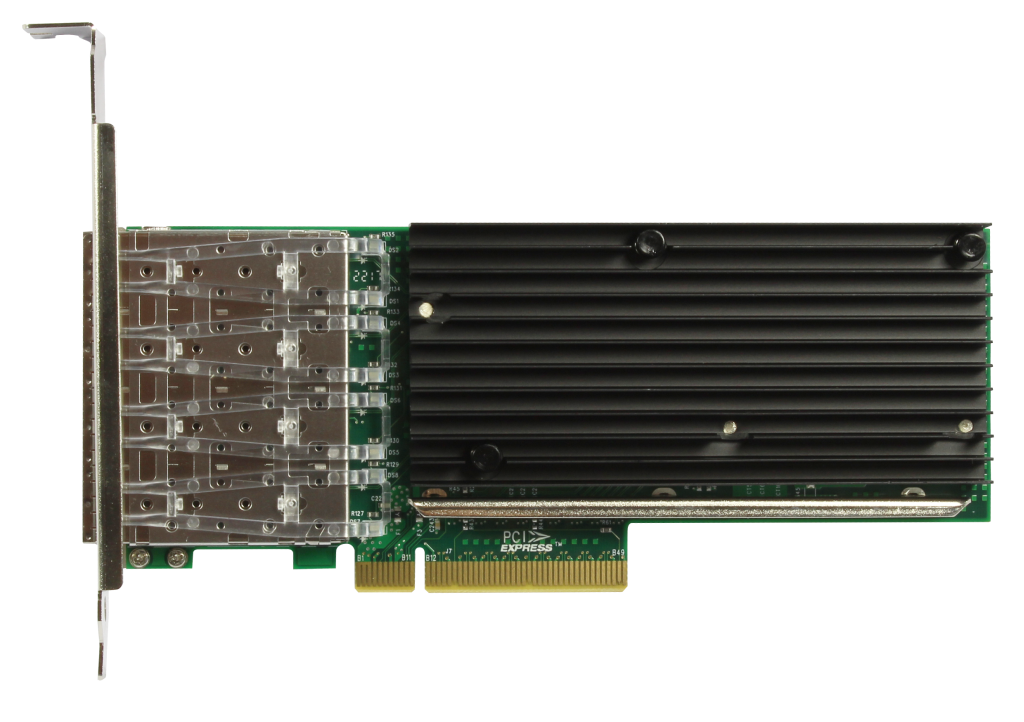
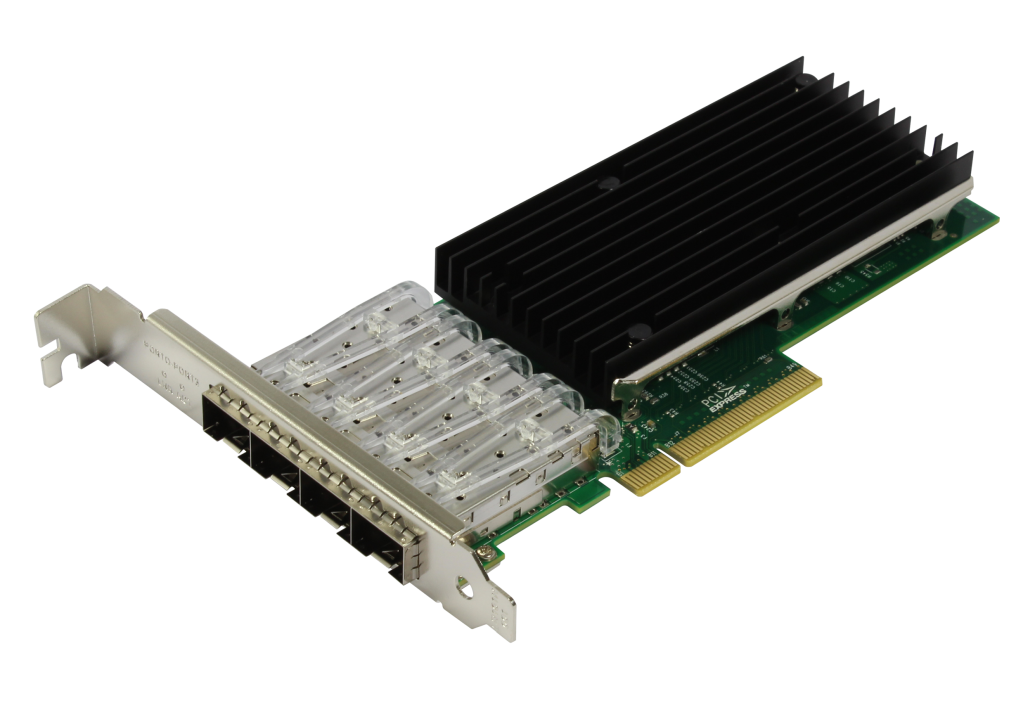
ALL0141-4SFP+-10G is ALLNET a new generation of high- performance server adapter, based on the Intel XL710-BM1 controller. The Server Adapter addresses the demanding needs of the next-generation agile data centre by providing unmatched features for both server and network virtualisation, flexibility for LAN and SAN networks and proven, reliable performance.
The ALL0141-4SFP+-10G adapter delivers superior performance in a PCI Express v3.0 x8 slot. Optimised performance vectors and key uses include:
Achieves wire-rate throughput on smaller payload sizes (>128 Bytes for 40 GbE and >64 Bytes for 10 GbE)
Delivers line-rate performance with low CPU usage for large application buffers
Network virtualisation overlay offloads including Geneve, VXLAN, and NVGRE
Enables competitive performance with native OS drivers and intelligent offload for NAS (NFS, SMB), and SAN (iSCSI and FCoE)
Key Features
A Complete, Unified Networking Solution
Converging data and storage onto one fabric eliminates the need for multiple adapters, cables and switches. Furthermore, both 10 and 40 gigabit Ethernet provides the bandwidth to converge these multiple fabrics onto a single wire. A key capability that makes all this possible is traffic class separation provided by Data Centre Bridging (DCB) providing a one-wire solution with virtual pipes for the different classes of traffic:
Power Savings Power efficiency is critical to IT specialists as energy consumption is a real OpEx concern.
The new generation of ALL0141-4SFP+-10G adapters are power misers. They deliver double the throughput with only half the power of the previous
Energy Efficient Ethernet (EEE) Reduces power consumption during periods of low data activity. Energy is used to maintain the physical layer transmitters in a "ready state? to transmit data on the wire. During periods of low data traffic, EEE sends a low-power idle signal to put the transmitters into a "low power state? saving power and cost. When data needs to be sent, EEE sends a normal idle signal to wake up the transmit system before data is due to be sent so there is no degradation of performance.
Server Virtualisation
With the INTEL Virtualisation Technology (VT), the ALL0141-4SFP+-10Gadapter deliver outstanding I/O performance in virtualized server environments. They reduce I/O bottlenecks by providing intelligent offloads for networking traffic per virtual machine (VM), enabling near-native performance and VM scalability. The host-based virtualisation technologies supported by Intel VT include:
Adapter-based VM queue sorting enabling efficient hypervisor-based switching
Adapter-based isolation and switching for various virtual station instances enabling optimal CPU usage in virtualised environments. Additionally, ALL0141-4SFP+-10G provide Virtual Bridging support that delivers both host-side and switch-side control and management of virtualised I/O as well as the following modes of virtualized operation: VEPA : IEEE 802.1Qbg support for Virtual Ethernet Port Aggregator VEB: Virtual Ethernet Bridge support via Intel® VT
Network Virtualisation
Network virtualisation is the next big trend in creating an agile data centre. The ALL0141-4SFP+-10Gadapter is ready to help you take that next step.
With Intel Virtualisation Technologyperformance for overlay networks. With these offloads it is possible to distribute network traffic across CPU cores. At the same time XL710 offloads LSO, GSO, and check-sum from the host software reducing CPU overhead.
Intel® Ethernet Flow Director
Flow Director is an advanced traffic steering capability built into the XL710 controller. It consists of a large number of flow affinity filters that direct receive packets by their flows to queues for classification, load balancing, and matching between flows and CPU cores. It eliminates context switching required within the CPU. As a result, Flow Director significantly increasing the number of transactions per second and reduces latency for cloud applications like Memcached.
Intelligent Offloads
The Intel Xeon processor family has demonstrated increased computing performance and increased integration of key server subsystems generation after generation. To offload is to leverage the ever-escalating computing power of the Xeon processor where appropriate and implementing complementary accelerations in the network controller?this is what Intel refers to as ?intelligent offloads.? By employing a balanced hybrid of compute and offload, intelligent offloads are able to achieve the optimised point of performance and efficiency. This is most notably observed in the following usage models:
Demonstrates leading performance vs. TOE solutions without restricting feature usage (TOE usage usually requires that key features be disabled). Supported stateless offloads include Checksum, TSO, VMDq, and RSS.
Providing exceptional performance without the need for full-offload HBA2 methods.
Trafficking data flows across multiple consumers and connections.
Manageability
ALL0141-4SFP+-10Galso incorporate the manageability required by IT personnel for remote control and alerting. Communication to the Board Management Controller (BMC) is available either through an on-board SMBus port or the DMTF-defined NC-SI, providing a variety of management protocols, including IPMI, BMC Pass-thru, OS2BMC, and MCTP/SMBus and MCTP/PCIe.
Features General
Intel® XL710-BM1 40 Gigabit Ethernet Controller SFP+ Connectivity Low-profile full-height Load balancing on multiple CPUs iSCSI remote boot support Fibre Channel over Ethernet (FCoE) support Support for most network operating systems RoHS-compliant Intel® PROSet Utility for Windows*Device Manager Time Sync (IEEE 1588*, 802.1as)
I/O Features for Multi-core Processor Servers
Intel® Flow Director MSI-X support Multiple queues: 1,536 Tx and Rx queues per port Tx/Rx IP, SCTP, TCP, & UDP checksum offloading (IPv4, IPv6) capabilities
Virtualisation features
Next-Generation VMDq Up to 256 maximum VMDq VMs supported PCI-SIG SR-IOV implementation (128 per device) Virtual Machine Load Balancing(VLMB) Advanced Packet Filtering VLAN support with VLAN tag insertion, stripping and packet filtering for up to 4096 VLAN tags VXLAN and NVGRE Support
Manageability Features
Preboot Xecution Environment (PXE) support Simple Network Management Protocol (SNMP) and Remote Network Monitoring (RMON) Statistic Counters iSCSI Boot Watchdog Timer
Adapter Product Features
Intel® PROSet Utility Plug and play specification support Receive Side Scaling
Advanced Software Feature
Adapter fault tolerance (AFT) Switch fault tolerance (SFT) Adaptive load balancing (ALB) Teaming support IEEE 802.3ad (link aggregation control protocol) PCIe Hot Plug*/Active Periphera component interconnect (PCI) IEEE 802.1Q* VLANs IEEE 802.3 2005* flow control support Tx/Rx IP, TCP, & UDP checksum offloading (IPv4, IPv6) capabilities (Transmission control protocol(TCP), user datagram protocol (UDP), Internet protocol (IP) IEEE 802.1p* TCP segmentation large send offload MSI-X supports Multiple Independent Queues interrupt moderation Ipv6 offloading ? Checksum and segmentation capability extended to new standard packet type
Network Operating Systems (NOS) Software Support
Windows Server* 2012 R2; Windows Server 2012 R2 Core; Windows Server 2012; Windows Server 2012 Core; Windows Server 2008 R2; Windows Server 2008 R2 Core; Linux* Stable Kernel version 2.6.32/3x; Linux* RHEL 6.5 and RHEL 7.0; Linux* SLES 11 SP3 and SLES 12; FreeBSD* 9 and FreeBSD* 10; UEFI* 2.1; UEFI* 2.3; VMware ESXi 5.1 (Limited Functionality); Vmware ESXi 5.5
Technical details:
Back |